EnotriumEdge ↓AI
Real-time,
Live Neural
Networks
A living nervous system that thinks, learns, and acts on-device while flying.
Intelligence for autonomous drones
Real-time, on-device learning that thinks while it flies.
Enotrium Edge AI is a proprietary intelligence layer for UAVs and edge systems. It replaces static, cloud-dependent models with live-thinking AI that adapts continuously during deployment — without retraining cycles, and without sacrificing latency or power.
Deployed on drones and industrial sensors, Enotrium Edge AI turns raw hyperspectral, RGB, and IoT data into autonomous decisions in austere, low-bandwidth environments.
Autonomous Machines
Enotrium Edge AI gives UAVs a real-time nervous system:
- On-device learning via local adaptation rules, not cloud retraining.
- Event-driven, low-power inference tailored to hyperspectral payloads and UAV-class hardware.
- Dual-timescale adaptation that stabilizes long-term memory while reacting instantly to new soil conditions, atmospheric interference, or sensor drift.
Rather than relying on pre-trained models, Enotrium UAVs continuously adapt to changing fields and environments, enabling autonomous resampling, anomaly detection, and material-routing decisions that close the loop between percepts and production.
Architecture: Perception, Adaptation, Action
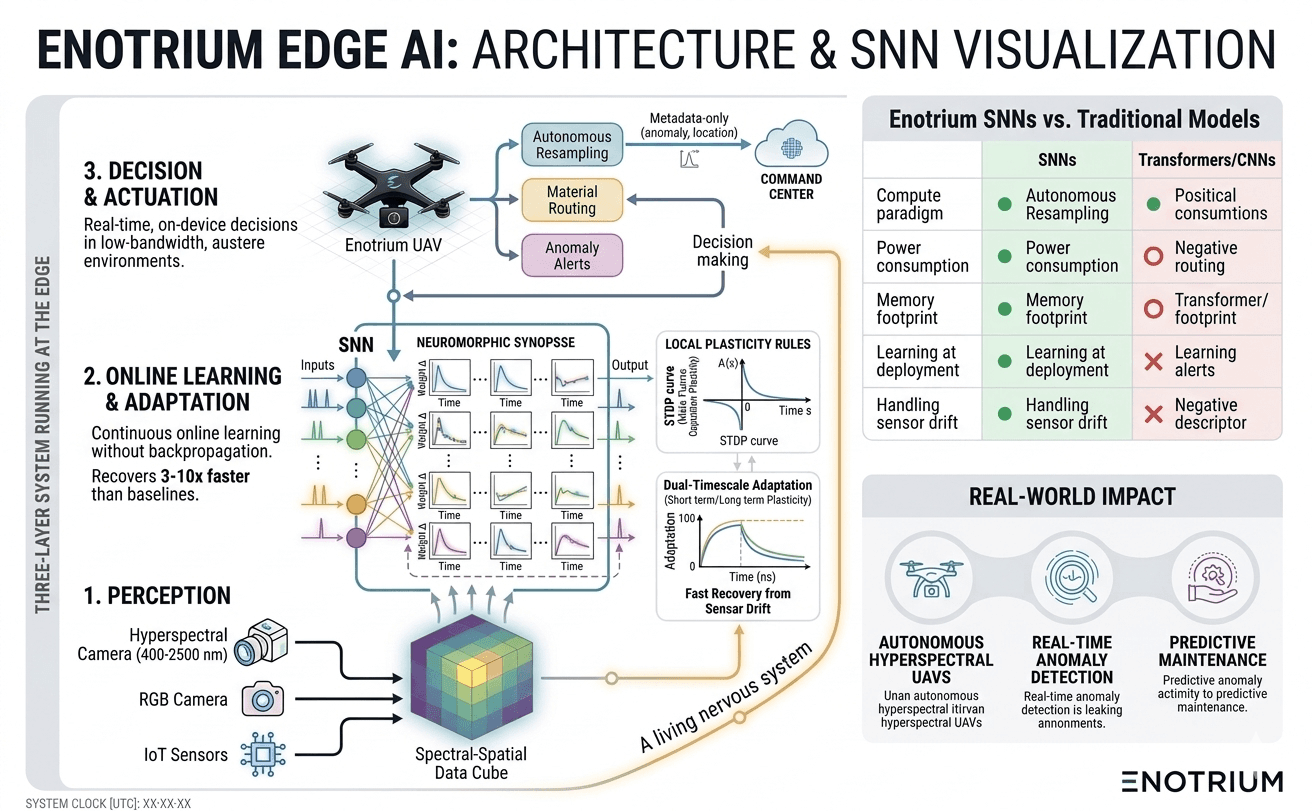
Enotrium Edge AI is a three-layer system that runs directly on the edge:
Perception
Hyperspectral (400–2500 nm, SWIR-focused), RGB, and auxiliary sensors feed spectral-spatial cubes into a custom neural architecture.
The neural processor handles full wavelength stacks in real time, detecting subtle chemical signatures, contaminants, and phytoremediation patterns that conventional models miss.
Online learning & adaptation
Proprietary on-device adaptation updates internal representations as distributions shift.
Models recover performance 3–10× faster than standard online baselines while maintaining deterministic, real-time latency.
Decision & actuation
Edge-AI agents onboard the UAV generate low-latency decisions:
- which sub-fields to rescan at higher resolution,
- when to trigger soil-remediation or bio-security alerts,
- how to route raw material directly to processing based on real-time spectral quality.
Metadata-only streams (coordinates, anomaly type, confidence) can be sent to command centers, preserving bandwidth while enabling closed-loop operations.
This architecture keeps data localized, minimizes bandwidth, and ensures deterministic latency — critical for autonomous, safety-critical UAV missions.
Architecting Enotrium
Where traditional transformers and CNNs are static, batch-heavy, and GPU-dependent, Enotrium Edge AI is built for the edge:
| Aspect | Transformers / CNNs | Enotrium Edge AI |
|---|---|---|
| Compute paradigm | Dense, batched, static inference | Event-driven, streaming, on-device adaptation |
| Power consumption | High (often GPU-class) | Orders of magnitude lower; fits UAV budgets |
| Memory footprint | Growing with model size | Constant-memory, fixed-point design |
| Learning at deployment | Static after deployment | Continuous online learning without retraining |
| Handling sensor drift | Degrades with distribution shift | Fast recovery via adaptive edge processing |
Enotrium's edge AI designs run on edge-class hardware, enabling implantable, drone-mounted, and industrial-IoT deployments from the same core architecture.
Intelligence on the Edge
Autonomous hyperspectral UAVs
Drones fly austere routes, continuously updating soil-chemistry and contaminant maps in real time.
When a field's spectral signature suddenly shifts (e.g., new pesticide runoff or PFAS spill), the edge AI triggers targeted resampling and routes the data to the Enotrium AIP's contracting layer, which can renegotiate offtake terms or reroute biomass to bio-remediation processing.
Deployed alongside partner agencies, this capability supports early warning for food and agricultural infrastructure — a sector identified by the Department of Homeland Security as critical to national security.
Real-time anomaly detection & find-fix-track
Edge AI detects spectral anomalies indicative of agroterrorism, microbial contamination, or engineered biological threats.
Metadata-only streams are sent to command centers, preserving bandwidth while enabling rapid, closed-loop decision-making.
Predictive maintenance & system health
Edge AI on UAV motors, batteries, and payload systems learn normal operating signatures and detect incipient failures.
Alerts queue preventive maintenance without waiting for offline model retraining, extending fleet life and reducing downtime.
From soil to sovereignty: AI at the edge
Enotrium Edge AI is not just a UAV-side accelerator. It is the live-thinking nervous system that connects:
- Raw hyperspectral percepts,
- Economic incentives in the Enotrium AIP,
- And physical material flows in downstream manufacturing.
By pushing intelligence to the edge, Enotrium ensures:
- Resilience against sensor drift and distribution shift,
- Autonomy in low-bandwidth or disconnected environments,
- Sovereign control over the agri-industrial supply chain — from soil to fiber, from drones to decarbonization.
Build the next generation of live-thinking UAVs
Integrate Enotrium Edge AI into your drone stack and deploy intelligence that adapts in real time, without cloud dependency.
Schedule a UAV-AI demo